

Man’s chief end is to glorify God, and to enjoy Him forever (Westminster Shorter Catechism)
Have you ever wondered at something? Of course you have. A new born baby. A sunset. The intricacies of a flower. Even the physical and intellectual powers of a gifted man, woman, or child. These draw out of us something that is in itself a bit of a wonder. Why should some things draw wonder out of us, when others are hardly noticed?
Obviously, God created us to wonder. He also created us to be a wonder.
Then God said, “Let Us make man in Our image, according to Our likeness…” Genesis 1:26a
And to be the instruments and bearers of His wonder.
Let your light so shine before men that they see your good work and glorify your Father in heaven. Matthew 5:16
So where has all the wonder gone?
One thing before we move to answer that question: First, I fear you will read this article as something less than a wonder. Stop for a moment and consider that God put this subject into my heart and head – for you to read. Because #iamjustthepen, there is the wonder of Him using me to produce something of value for His kingdom. Why my hands? Why now? Let’s wonder together what He might be up to.
The Meaning of Wonder
As a Christian, whenever we wonder about something, our intention should be to find God’s meaning in it. So, from Blue Letter Bible’s Outline of Biblical Usage, we find there are generally two meanings for wonder: the wonder itself and people’s response to that wonder. Here are both, in their Hebrew and Greek definitions.
pele’ (Hebrew) – wonder, marvel; wonder (extraordinary, hard to understand thing); wonder (of God’s acts of judgment and redemption).
teras (Greek) – a prodigy (i.e., phenomenon), portent (i.e., sign); miracle: performed by any one.
tāmah (Hebrew) – to be astounded, be stunned, be amazed, be dumbfounded.
thambos (Greek) – astonishment, amazement.
Nothing surprising, except perhaps the use of prodigy as the primary meaning – perhaps suggesting people are God’s primary wonders. Hmm. We may have to come back to that.
Wondering About Wonder
If we give attention to something – to wonder how or why it could be so, then it just might become a wonder to us. Take for example the presence of God.
Can anyone hide himself in secret places,
So I shall not see him?” says the Lord;
“Do I not fill heaven and earth?” says the LORD. Jeremiah 23:24
We understand that the LORD is everywhere, all the time (see also Psalm 139:7-10). And, Jesus is particularly present when two or three are gathered together in His name (Matthew 18:20). Is this not a wonder? Should it not be a wonder every time we gather together, whether it’s over lunch or in the sanctuary? This is the power of proper attention: to become what we give our attention to.
And this is just the every day wonder (if we should call it that)! What about the sacramental moments God has instituted for our intimacy with Him?
Like so many others, my fellowship’s church service begins with prayer (i.e., talking to God). That should be a time of wonder. Then we worship God through song; perhaps the time when we most expect to enjoy the presence and consequential wonder of God. Next comes the most time-invested portion of our gathering: the preaching/teaching of God’s word. Finally, there is the time of sacrament, when we enter into communion with God and one another.
Where is the wonder to be found in all this? Why do I – this is a confession – find so little wonder in it? Who is responsible for my finding the wonder of God’s presence in our gathering?
The answer may surprise you (as it has me). Responsibility for our wonder rests in three places: God’s, ours, and ours together.
First of all, God has taken responsibility for our wonder. He has made us wonderers, and He has promised His presence. Conversely, Scripture shows a sobering pattern: God’s manifest presence among His people was never something Israel could presume, apart from their covenant faithfulness (Exodus 33:3, Isaiah 59:2, Ezekiel 10:18–19). We stand in a New Covenant with better promises (Hebrews 13:5) — but the warning still teaches us that our wonder of God is important to Him. Might He remove His presence? Why show up when those present are not there to properly wonder in His presence?
Secondly (and this was my immediate response), each of us is responsible for our wonder at God in His presence with us. We have been given eyes to see and ears to hear the wonders of God. It would do us good to ask, “Why am I here?” And, “What am I giving my attention to?” The Babylon Bee recently posted a meme that might step on a few toes:
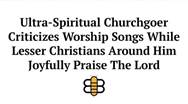
Not to excuse legitimate concerns about our worship songs, but perhaps critical shouldn’t be our going in position. Time is too short, and God too wonderful, to waste time fretting over less significant matters.
Lastly (this was the surprise for me), we are collectively responsible for our wonder in the presence of God: leaders and congregants alike. God inhabits the praises of His people (plural). He responds to our loving fellowship and unity with one another. The time of greeting, hugging, and handshakes is not wasted. Leaders should be intentional to bring the body together.
And they continued steadfastly in the apostles’ doctrine and fellowship, in the breaking of bread, and in prayers. Then fear came upon every soul, and many wonders and signs were done through the apostles. Acts 2:42-43
“Why are we here?” and “Why should we be here?” are two good questions to regularly ask, by both worship leaders and attendees.
To those called to preach and teach, as one of you myself, two questions for your consideration. First, is the word of God still a wonder to you? Second, do you allow God to make it the same for your audience?
This is a matter for serious consideration. A. W. Tozer draws exactly this distinction between information and encounter:
Between the scribe who has read and the prophet who has seen there is a difference as wide as the sea… The Church waits for the tender voice of the saint who has penetrated the veil and has gazed with inward eye upon the Wonder that is God.
The world has taught us to teach, and to listen to teaching, for information transfer. We must ask ourselves, “Has the desire to teach and learn replaced the desire for God’s presence?”
Furthermore, in the Protestant church services I am aware of most attendees invest most of their time being preached at and taught to. Teachers and preachers should either become better instruments of God’s wonder, or give their time over to more wonder-filled investments of people’s time. Teaching with wonder is the obvious preferred option, and something encouraged in Scripture.
And my speech and my preaching were not with persuasive words of human wisdom, but in demonstration of the Spirit and of power, that your faith should not be in the wisdom of men but in the power of God. 1Corinthians 2:4-5
As a teacher myself, I find this to be a daunting task; and so it should be. Fortunately, we can do all things through Christ, who gives us strength (Philippians 4:13). Abiding in Him, and His words abiding in us, we can “ask what you desire, and it shall be done for you. By this My Father is glorified, that you bear much fruit; so you will be My disciples (John 15:7-8).”
God’s Primary Wonders
I have a dear friend of 20+ years who taught me something wonderful the first time I heard him speak. He wasn’t preaching or teaching to an audience, just answering a question most of us have heard at least once: “Why do you come to this class?” Most of us answered in the way one would expect: to learn something.
My friend’s answer was a bit more profound (i.e., filled with wonder). It went something like this: I am here to find the Christ in you, because my experience of Christ is not complete apart from the presence of Christ in His body.
Not only are we created in the image of God, we are vessels of His presence…
But we have this treasure in earthen vessels, that the excellence of the power may be of God and not of us. 2Corinthians 4:7
And instruments of His wonder…
Therefore they stayed there a long time, speaking boldly in the Lord, who was bearing witness to the word of His grace, granting signs and wonders to be done by their hands. Acts 14:3
What does all this mean? The wonders of God are no farther from us than His presence; and His presence no farther than the assembly of the saints. We become the wonder of God to the world around us by giving proper attention to the wonder in our midst.
Going Deeper
The wonder of God’s presence was never meant to be learned as a theory. Consider the following deeper questions before you move on – both alone and amongst the people with whom you regularly gather.
- Think back to the last time you gathered with other believers — greeting, singing, sitting under the word, receiving the elements. At what point, if any, did you actually expect to be surprised by God?
- In what ways have you let information transfer replace an expectation of encounter — in your own devotional life, or in how you listen to a sermon?
- Where do you see God’s presence being treated as ordinary — background, assumed — rather than a wonder actively noticed?
- What would it mean if you walked into your next gathering assuming God intended to show up in a way worth remembering?
- What does it cost you to actually pay attention — to God, and to the people around you who carry His presence?
Final Word
The LORD woke me up in the middle of the night to put on a finishing touch. Here is what He said He is after:
- Don’t just wrestle with the text; wonder in it.
- Don’t play with their emotions; present them to the LORD.
- Don’t just remember the Lord in communion; re-member Him in its sacraments.
- Stop asking for what you think you want; ask what He desires.
- Stop pursuing your identity in Christ; lose yourself in His presence.
- Get out of your head; start searching for Him with your heart.
- Stop looking for what’s broken in the other; find in them the rest of Christ’s body.
- Move on from milk to meat; and from foundation to mystery.
- Stop sitting around waiting for Him to show up; take Him where He has co-missioned you to go.
- Stop saving your life for tomorrow; lose it for Jesus’ sake and for the sake of the gospel.
- Escape from that critical spirit; wonder that God would use such imperfect beings as vessels and instruments of His glory.
- Love one another; anticipate His presence in your fellowship.
- Stop analyzing what God is doing; start enjoying every little thing He does.
- Stop concerning yourself with tomorrow’s good work; enjoy His presence today.
Wow! That’s a lot. Some are obvious; others, not so much. Hopefully, one or more will be a word of faith for you. Let those word(s) settle in your heart, choose to obey, and then walk in His good and glorifying work. And as you go, my God bless you with sharper vision and hearing for the wonders of His kingdom.
Have a strong day in the Lord,
Rob
#iamjustthepen
Bible Presbyterian Church General Synod. (n.d.). Westminster Shorter Catechism: Question 1. https://bpc.org/sc-q1
Peterson E. (2000). A Long Obedience in the Same Direction: Discipleship in an Instant Society. Intervarsity Press; Downers Grove, IL